Love & relationships
The Fool can describe freshness, playfulness or a relationship entering unfamiliar territory. Instead of assuming “new love is coming,” ask whether you are allowing discovery while keeping boundaries visible.
The Fool is traditionally associated with beginnings, openness and stepping forward before every detail is known. The useful question is not “should I leap?” but “what is safe enough to test?”
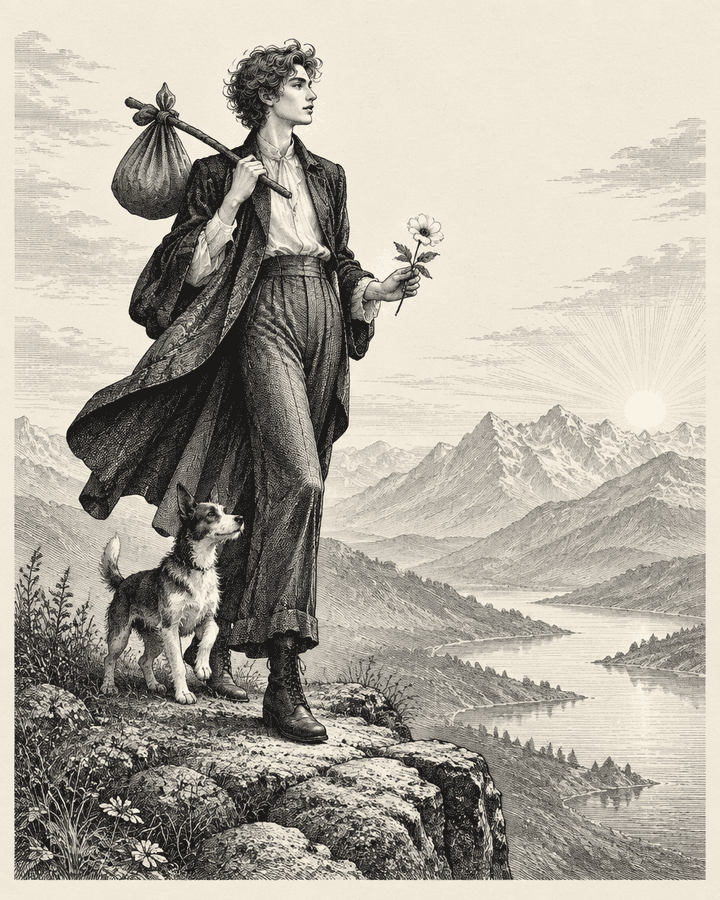
The Fool points to the moment before expertise: curiosity is high, certainty is low, and movement is possible. It can invite a beginning—but it also asks what you have not checked yet.
Tarot imagery works best when you notice the scene before jumping to a keyword. Hunch’s original artwork keeps the traditional symbolic vocabulary but uses a new composition.
A boundary between what is known and what has not yet been tested. It can represent possibility and exposure at the same time.
Feedback, instinct or a companion signal. In Hunch’s image, the dog is alert: enthusiasm still benefits from information.
Curiosity and openness. It keeps the scene from becoming purely about danger.
You may not have everything, but you are not empty-handed. Ask what is already enough to begin.
Upright, The Fool often points to a beginning, experimentation, beginner’s mind, trust or movement. It can be especially useful when perfectionism is masquerading as preparation.
The card does not require reckless optimism. A strong upright reading makes room for both excitement and design: choose a first step that teaches you something without demanding an irreversible commitment.
A reversed Fool can suggest hesitation, avoidable risk, impulsiveness or motion without enough attention. Sometimes it describes staying at the edge for too long; sometimes it describes stepping off it without checking the ground.
Ask which problem is actually yours: excessive caution, or insufficient preparation. Those require opposite responses.
Reversals are optional in tarot. Treat this as one reading tradition, not an objective opposite or diagnosis.
The Fool can describe freshness, playfulness or a relationship entering unfamiliar territory. Instead of assuming “new love is coming,” ask whether you are allowing discovery while keeping boundaries visible.
It can fit a new role, project, business idea or learning curve. A useful reading is to define the cheapest experiment that can produce real feedback.
The Fool is not a signal to gamble. If money is involved, separate enthusiasm from downside: what can you afford to test, and what loss would materially hurt?
The card can lean toward movement when the next step is reversible and informative. If the downside is large or unclear, gather evidence first.
Hunch lens: The Fool is less useful as “take a leap” than as permission to be a beginner while still respecting reality.
Yes / no? Not a fixed yes. The reflective lean is “explore,” provided you can name the real risk and make the first move small enough to learn from.
It often carries an open, forward-moving tone, but “positive” is too simple. Its value comes from holding possibility and risk in the same image.
It can point to novelty, openness or entering unfamiliar relationship territory. Use it to ask what you are discovering and which boundaries still matter.
Common reversal themes include hesitation, impulsiveness, avoidable risk or a start that needs more attention.
Hunch does not treat the card as a factual yes/no oracle. It can lean toward exploration when the next step is reversible and adequately checked.
Turn your photo into original tarot art and use the card as a reflective prompt, not a fixed prediction.
Create my personal card ↗