Tarot Card
Meanings
Learn the traditional language of the cards without treating it as a fixed script. Hunch combines familiar tarot symbolism with concrete questions you can use in real life.
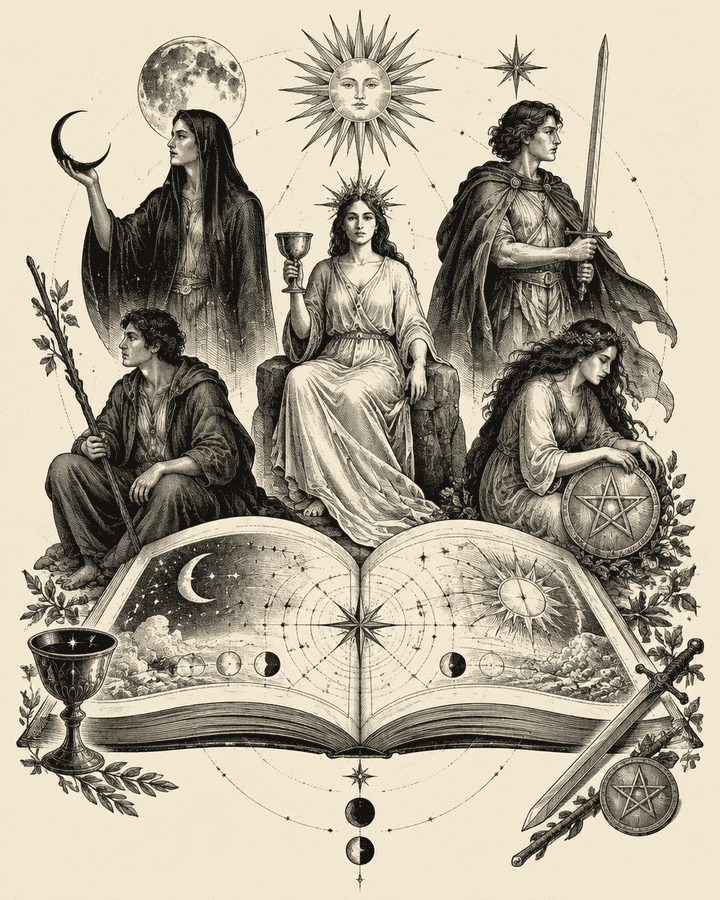
What do tarot cards mean?
Tarot has 78 cards: 22 Major Arcana and 56 Minor Arcana. A card’s meaning comes from its imagery, traditional associations, the question being asked and its position in a spread—not from one sentence that is always true.
Different decks and readers emphasise different details. Hunch uses familiar Rider–Waite–Smith-style symbolism as a shared reference, then asks what the image helps you notice now. The goal is reflection, not certainty about the future.
Where should you begin? Explore all 22 Major Arcana meanings for larger patterns, or the 56 Minor Arcana cards for everyday experiences. Compare The Fool (a beginning worth testing) with The Sun (clarity worth verifying), then try a free three-card reading to put the meanings in context.
Look. Locate. Reflect. Choose.
Memorising keywords can help, but a useful reading begins before the keyword. Try this four-step method with any card.
Look. Name what is visibly happening before interpreting it.
Locate. Separate familiar tarot associations from the facts of your situation.
Reflect. Ask what tension, resource or blind spot the image highlights.
Choose. End with an action or question that remains yours.
A worked example: The Fool
Suppose you are considering a new project. “The Fool means leap” is too blunt. A Hunch reading asks: what is the smallest reversible step you could take, what risk is actually real, and what feedback would tell you whether to continue?
Read The Fool meaning ↗Major and Minor Arcana.
The Major Arcana are the 22 numbered archetypal cards from The Fool through The World. Readers often use them for larger patterns, turning points or identity-level questions.
The Minor Arcana are 56 cards in four suits. In the common modern system, Wands often point to energy and initiative, Cups to feeling and connection, Swords to thought and conflict, and Pentacles to material life and practical resources. These are conventions, not physical laws.
| Part of deck | Cards | Useful lens |
|---|---|---|
| Major Arcana | 22 | Archetypes, larger themes, transitions |
| Wands | 14 | Energy, drive, creativity, initiative |
| Cups | 14 | Emotion, relationships, receptivity |
| Swords | 14 | Thinking, communication, tension, decisions |
| Pentacles | 14 | Work, resources, body, practical reality |
Explore the Major Arcana.
Beginnings without blind faith
Openness, risk and the next reversible step.
Agency through available resources
Skills, tools and turning intention into action.
Intuition without false certainty
What you know, what you sense and what remains unknown.
Growth with enough support
Nurture, abundance and what needs steady care.
Structure that can hold
Boundaries, responsibility and useful authority.
Tradition examined consciously
Rules, teachers and which structures still serve you.
Choice through alignment
Connection, values and the decisions relationships reveal.
Direction before acceleration
Momentum, control and competing forces moving together.
Solitude with a purpose
Reflection, inner guidance and knowing when to return.
Change without surrendering agency
Cycles, timing and the choices that remain yours.
Evidence before verdict
Fairness, standards and accountability without cosmic scorekeeping.
Hope with evidence
Renewal, orientation and small proof that repair is happening.
Uncertainty without mind-reading
Separate what you observe from the story you build around it.
Clarity without forced positivity
Visibility, joy and what the evidence makes easier to see.
Major and Minor Arcana.
A standard tarot deck has 22 Major Arcana and 56 Minor Arcana. Use the Major Arcana for the broad archetypal sequence and the Minor Arcana for four suits of more immediate situations, behaviours and relationships.
Draw, compare and reflect.
Reading a meaning is easier when you can test it against a real question. Hunch tools keep the card visible, explain the interpretive lean, and leave the decision with you.
Need a quick directional prompt? Try a one-card Yes or No Tarot draw and read why the card leans Yes, No or Not yet.
Want more context? Use the Free Tarot Reading for Situation, Tension and Next Step.
Just want one random card? Open the Tarot Card Generator and optionally include reversals.
Looking for your birth-card pair? Try the Tarot Birth Card Calculator and see the method behind the result.
Two lenses, not two verdicts.
An upright meaning usually reflects the card’s most familiar expression. Readers who use reversals may treat an upside-down card as blocked, internalised, delayed or overexpressed energy. Other readers never use reversals at all.
Hunch treats reversal meanings as one optional tarot tradition, not as a factual opposite. If a reversed keyword makes you ignore what is actually happening in your life, the keyword is not helping.
How to interpret common tarot symbols.
Symbols give you questions to investigate, not facts about someone's intentions or the future. Their meaning changes with the image, spread position and the situation you are actually considering.
Water: notice whether it is calm or turbulent. Could emotions be acknowledged more clearly? In The Moon, uncertain terrain asks for patience before concluding.
Lantern: a small source of light can suggest focused attention rather than total certainty. The Hermit invites you to distinguish useful solitude from avoidance.
Tower: a shaken structure can represent an assumption being challenged. With The Tower, ask what has actually changed and what practical support is available.
Roads and paths: a visible choice or crossing can prompt questions about trade-offs, direction and information you still need. Test interpretations against observable facts before taking action.
For a repeatable method, see how to read tarot.
Before you memorise the deck.
Do tarot cards have fixed meanings?
No single wording is universal. Historical traditions, deck imagery, spread position and reader method all affect interpretation. Use keywords as orientation, not as immutable rules.
How many tarot cards are there?
A standard modern tarot deck has 78 cards: 22 Major Arcana and 56 Minor Arcana.
Do I have to read reversed cards?
No. Some readers use reversals and others do not. A consistent method matters more than forcing an upside-down card into an opposite meaning.
Can beginners read tarot?
Yes. Start by describing the image, learn a few core associations and ask one grounded reflection question before trying to memorise every keyword.
Turn your photo into tarot art.
Hunch takes the symbolic language you are learning and turns your own image into a personal card and reflective reading.
Create your personal tarot card ↗