Love Tarot Spread
For a fast relationship check, use three positions that keep your own stance separate from what you can actually observe and from the pattern created between you.
Try the full 5-card love reading ↗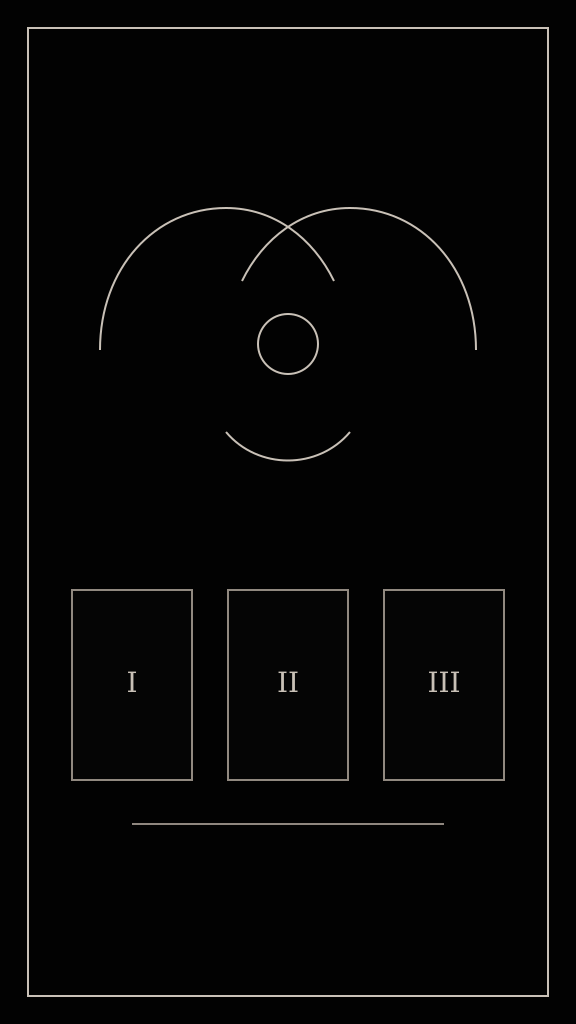
You · What is observable · Connection
What you bring
Your need, expectation, behaviour, boundary or fear — the part of the dynamic you can examine directly.
What is observable
Words, actions, consistency, timing or behaviour you have actually seen. Do not use this position to claim secret feelings.
What happens between you
The pattern created when your stance meets the observable signals: reciprocity, distance, intensity, ease, ambiguity or friction.
It blocks the easiest relationship-reading mistake.
Many love spreads include a “Them” position. That can tempt a reader to treat a card as access to another person's private thoughts. Hunch replaces that position with What is observable.
If a card suggests warmth but the person's behaviour is inconsistent, the card does not override the evidence. Ask what you are noticing, what you are assuming and what needs to be asked directly.
Synthesize the triangle.
Read each card only inside its assigned position.
Look for agreement or contradiction between You and Evidence.
Use Connection to name the pattern those two create together.
End with one conversation, boundary or observation that could reduce uncertainty.
Example: if You is Queen of Cups, Evidence is Two of Pentacles and Connection is The Moon, the grounded reading is not “they secretly feel X.” It is that emotional availability is meeting variable signals, creating ambiguity that needs clearer evidence or a direct conversation.
Use more positions only when they answer a new question.
For a quick check, early dating, mixed signals, or when you mainly need to separate interpretation from observable behaviour.
When you also need dedicated positions for friction and the next conversation. The full Hunch reading is interactive.
Keep the jobs distinct.
Single & dating
What I seek · What I repeat · What to practice.
After conflict
What I know · What I assume · What to ask.
Established relationship
What works · What costs us · What to renegotiate.
After a breakup
What I am carrying · What I can release · What self-respect looks like now.
Three cards for a relationship question.
Try three positions: My perspective, What needs attention, and My next conversation. If you draw The Lovers, Two of Swords and Temperance, the sequence could suggest naming the values you care about, recognising a choice you have postponed, and speaking with patience rather than guessing how the other person feels.
After the spread, write one sentence for each position: “I feel…”, “I have observed…”, and “I want to ask…”. This keeps the reading grounded in your own decisions. For a richer interactive experience, try the five-card love tarot reading, or study The Lovers card meaning.
About love tarot spreads.
Can a love tarot spread tell me how someone feels?
Not as a fact. A spread can help you examine your reaction to behaviour, but direct communication and consistent actions are better evidence of another person's intentions.
What question should I ask?
Prefer “What should I understand about this dynamic?” or “What would make this situation clearer?” over questions that demand access to another person's mind.
How is this different from Hunch's Love Tarot Reading?
This page teaches a compact three-card layout you can use with any deck. The Love Tarot Reading is a five-card interactive experience with separate positions for friction and the next conversation.