Three Card Tarot Spread
Draw three cards to look at where a pattern comes from, what is active now and where the current direction may lead. The third card is a trajectory, not a fixed prediction.
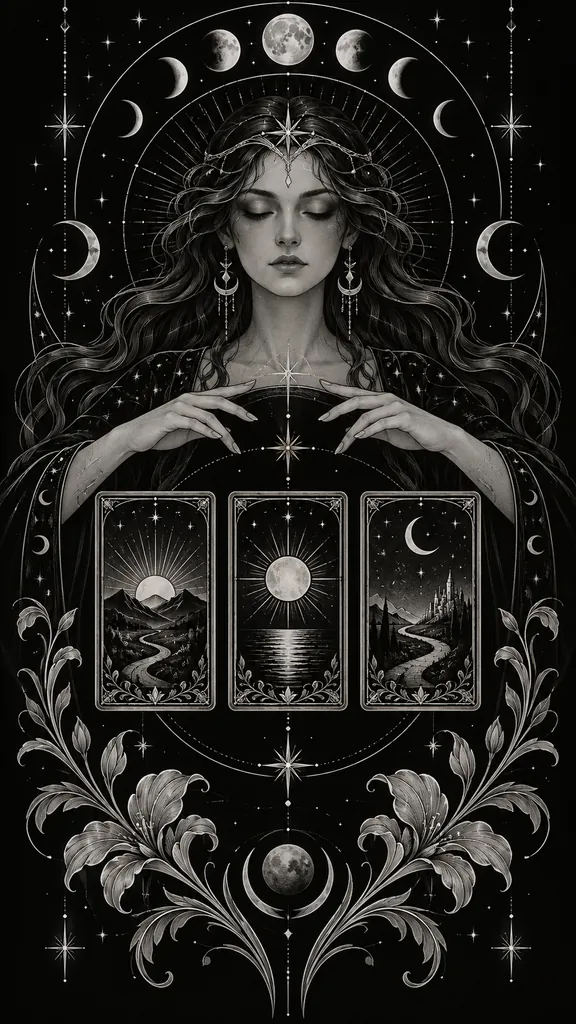
Past · Present · Future
Ask a question, or leave the draw open.
Read the movement
Reality-check questions
Three cards, three jobs.
Past is the context or pattern that still matters. It does not have to describe your whole history.
Present names what is most active now: the behaviour, condition or tension that deserves attention.
Future describes a plausible direction if the current pattern continues. Read it as a consequence to test, not a promise.
The useful question is not “Will this happen?” but “What would make this direction more or less likely?”
Keep the structure; change the jobs.
Best when you need an actionable reading. Hunch also has a dedicated version of this spread.
Useful when you already understand the situation but need behavioural choices.
Useful for uncertainty, conflict or decisions where evidence matters.
Do not read three mini-fortunes.
Name each card in its position.
Find one repeated theme or contradiction.
Describe what changes across the sequence.
Turn the Future card into a condition you can influence or observe.
Worked example
If Past is The Hermit, Present is The Chariot and Future is Temperance, a grounded synthesis might be: a period of withdrawal has produced clarity; now momentum is returning; the risk is overcorrecting, so the next phase depends on pacing and integration rather than speed alone.
Past, Present and Future without fixed predictions.
Think of the Past position as the context that shaped today’s situation, Present as the choice or tension you can observe now, and Future as a possible trajectory if the current pattern continues, not an event that must happen.
Example: The Hermit (Past) can represent a period of reflection; Justice (Present) asks what a fair decision requires; The Star (Future) invites a small step toward renewed confidence. A useful synthesis is to gather your evidence, make a balanced choice and notice what improves. Compare individual symbols in the tarot card meanings guide, or use the alternative Situation, Tension, Next Step reading when your question is about what to do now.
About three-card tarot spreads.
Is Past, Present, Future good for beginners?
Yes. The positions are easy to remember, but the spread still teaches an important skill: meaning comes from both the card and its position.
Can I use reversed cards?
Yes. Hunch treats a reversal as blocked, delayed, internalised or overused energy rather than automatically the opposite of the upright card.
What if the Future card looks difficult?
Treat it as information about direction and conditions, not an unavoidable event. Ask what current behaviour would strengthen that pattern and what action could interrupt it.
Should I redraw if the spread makes no sense?
First check the positions and your question. Often the useful move is to identify which card feels hardest to connect and ask what assumption would make that card relevant. Repeated redraws can turn reflection into answer-shopping.