Tarot Spreads
A tarot spread is simply a layout in which each card has a job. The best spread is usually the shortest one that gives your question enough structure.
Try a three-card spread ↗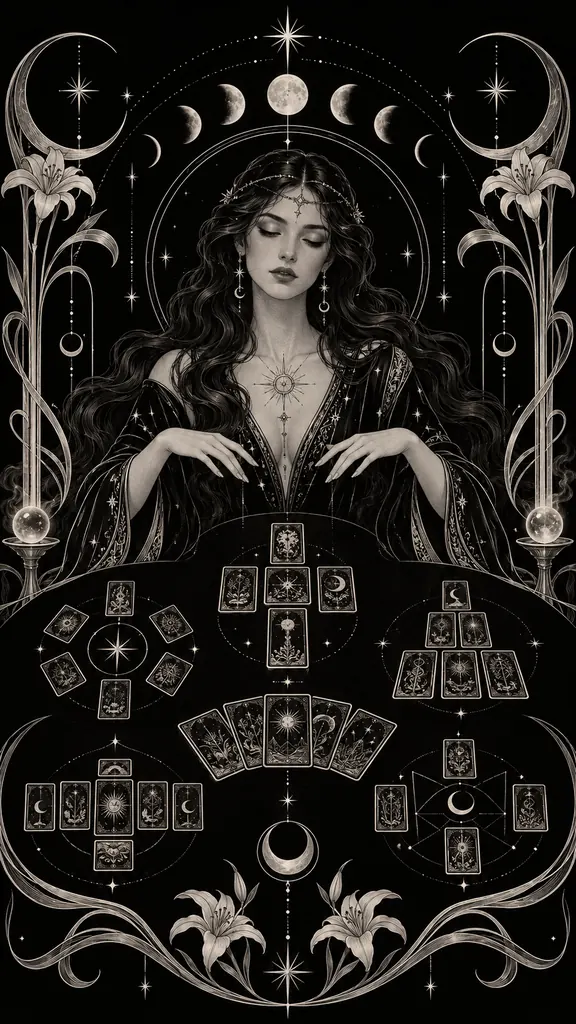
Choose the spread by the problem.
Use one card when you need focus, three cards when you need a relationship between ideas, and five cards when the situation has several people or forces that should not be collapsed into one answer.
More cards do not automatically create more insight. A spread becomes useful when every position asks a distinct question and the cards can be read together as one pattern.
Use one card or Yes/No to expose your reaction and the fact you still need.
Use three cards to compare context, tension or trajectory.
Use five positions so your stance, the connection and the friction stay separate.
Pick a layout.
One Card
Draw a single card from the 78-card deck and use it as one lens rather than a complete answer.
Past · Present · Future
Read where a pattern comes from, what is active now and where the current momentum may lead.
Situation · Tension · Next Step
A Hunch spread built to end with agency: name what is happening, what complicates it and what you can do next.
Love & Relationship
Separate your stance, observable signals, the connection, the pressure point and the next conversation.
Love Tarot Spread
Separate what you bring, what is observable and the dynamic created between you.
Ten Card / Celtic Cross
Use a ten-position spread when the question has several interacting layers.
The label changes the card.
A card does not mean exactly the same thing in every position. The Hermit in a Present position may describe deliberate withdrawal now; in a Next Step position it may suggest reducing noise before acting. Read the card through the job assigned to its place in the spread.
A simple synthesis rule
- Read each position separately.
- Name the strongest agreement or contradiction between cards.
- Ask what changes from the first position to the last.
- End with one observation, question or action you can verify in real life.
Which tarot spread should you use?
One card is useful for a short daily reflection: notice a pattern and decide on a small action with the daily tarot card. Three cards give a beginning, middle and possible direction: use the Past, Present and Future layout when you want to trace a situation over time.
For a relationship, the love tarot spread examines the perspectives and dynamics involved; it cannot reveal another person’s private thoughts. A ten-card spread offers more room for competing factors, but a larger spread is not automatically more accurate. If you would rather draw and receive an interpretation immediately, start a free tarot reading.
Love tarot: three cards or five?
For an uncomplicated question, the three-card love spread is a useful starting point. It encourages you to name your perspective, the relationship dynamic and the next conversation you can actually have.
If the situation has competing feelings or boundaries, the interactive five-card love reading gives more room to reflect. Neither format can verify what someone else thinks. Prefer a Past, Present and Future spread when you want to examine how a pattern developed, rather than focus on a relationship conversation.
About tarot spreads.
What is the easiest tarot spread for beginners?
A one-card draw is easiest for learning individual cards. A three-card spread is usually the best next step because it teaches how position and sequence change meaning without creating too many moving parts.
How many cards should I use?
Use the smallest number that gives each important part of your question a distinct position. If two positions are asking essentially the same thing, the spread is probably larger than it needs to be.
Do I have to use Past, Present and Future?
No. Three positions can also be Situation / Tension / Next Step, Mind / Body / Action, or any other set with clear non-overlapping roles.
Can a spread predict the future?
Hunch does not treat tarot as evidence of a fixed future. A Future position is more useful as a direction or consequence to examine if current patterns continue.
Want the card to look like you?
Hunch can turn your photo into original tarot artwork.
Create your card ↗