10 Card Tarot Spread
Ten cards are useful when a question has several forces that should not be collapsed into one answer. Read the spread in layers, then treat the final card as a direction to test — not a fixed outcome.
Ask one complex question.
Use ten cards when you need context, pressure, perspective and direction — not just more cards.
Read the spread in layers
Reality checks
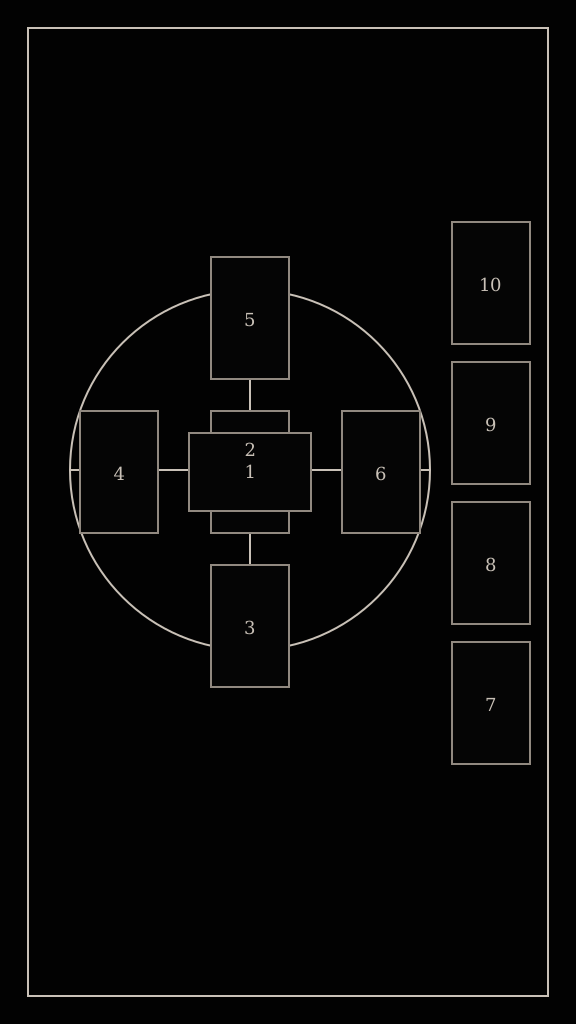
A practical Celtic Cross map.
| # | Position | Question |
|---|---|---|
| 1 | Present | What is central now? |
| 2 | Challenge | What crosses or complicates it? |
| 3 | Root | What underlying condition feeds it? |
| 4 | Recent past | What still shapes the present? |
| 5 | Conscious aim | What are you reaching toward? |
| 6 | Near-term opening | What may develop if the pattern continues? |
| 7 | Your stance | How are you approaching it? |
| 8 | Environment | What external condition matters? |
| 9 | Hopes & fears | What desire or anxiety colors the reading? |
| 10 | Current direction | Where do these forces point now? |
Read pairs, not ten mini-fortunes.
Present + Challenge names the live tension. Root + Recent past separates the deeper condition from the event that surfaced it. Aim + Near-term opening compares what you want with what the current pattern can support. Your stance + Environment separates your interpretation from external conditions. Hopes/fears + Current direction checks whether desire or anxiety is turning direction into prophecy.
The tenth card is not “what will happen.” It is the direction produced by the spread as it stands. Ask what would strengthen, weaken or redirect it.
Complexity should earn its place.
Use a ten-card spread when a question contains several interacting layers. If your question can be understood through context, tension and next step, use a three-card spread instead.
More positions create more interpretive freedom. The discipline is to keep every position distinct and synthesize the relationships between them.
About ten-card tarot spreads.
Is a 10-card tarot spread the same as the Celtic Cross?
The Celtic Cross is the best-known ten-card layout. Position names vary, but the structure usually covers present, challenge, foundations, direction, self, environment, hopes or fears and an outcome or direction.
Is the Celtic Cross good for beginners?
It is easier after you are comfortable synthesizing three cards. With ten positions, the main skill is deciding which relationships between cards matter most.
Should I read reversals?
Only if reversals are already part of your method. They are optional; ten positions already provide substantial nuance.
Can I redraw one confusing card?
Usually keep the original and clarify the position first. If you add a clarifier, name exactly what the extra card is meant to explain.