What Is Tarot?
Tarot is a 78-card picture deck that began as a European card game and was later adapted for divination. Today people also use it as a structured way to reflect on a question through images, positions and interpretation.
Try a three-card spread ↗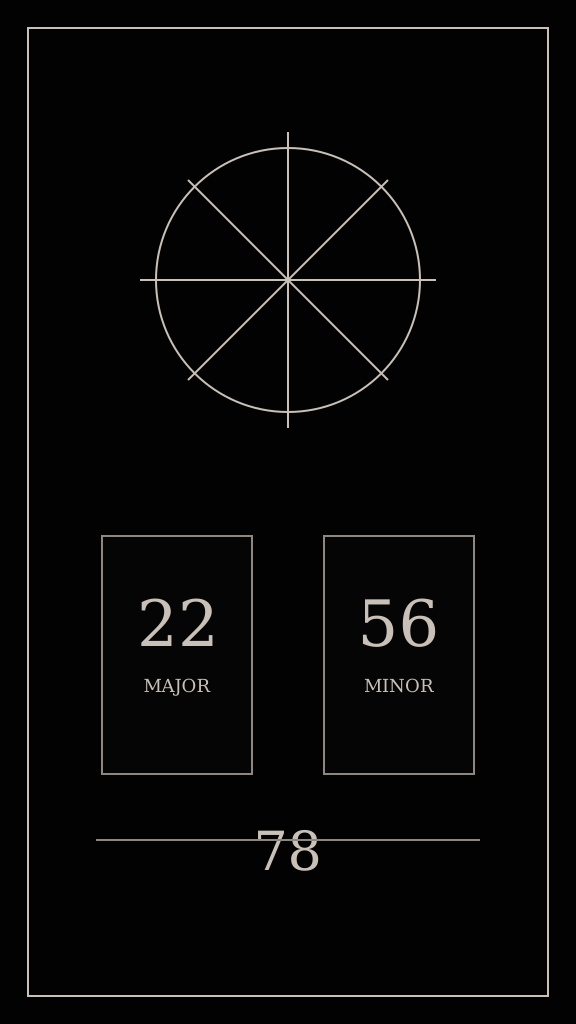
A deck with structure, not a single meaning system.
A standard tarot deck has 78 cards: 22 Major Arcana and 56 Minor Arcana. A reading assigns cards to a question or spread position, then interprets imagery and traditional themes in that context.
Different decks and traditions vary, so tarot is not one fixed dictionary. A useful reading separates the card itself, the job of its position and the inference made from the combination.
22 Major + 56 Minor.
Named trump cards such as The Fool, The Lovers, The Tower and The Sun. They often foreground a larger pattern, transition or archetype.
Four suits with numbered cards and court cards. In many modern decks these are Wands, Cups, Swords and Pentacles.
The Victoria and Albert Museum describes the standard tarot as 22 triumph or Major Arcana cards plus 56 pip or Minor Arcana cards, and its collection traces tarot decks from the 15th century to today.
Game first. Divination later.
The earliest references to tarot cluster in northern and central Italy. The Metropolitan Museum of Art notes references around Venice, Milan, Florence and Urbino, where trump cards were added to existing suit-card structures.
Tarot circulated as a trick-taking card game. Surviving Italian decks show that the cards existed long before modern occult systems were attached to them.
Tarot was increasingly reinterpreted for fortune-telling, esotericism and personal symbolism. Modern practice mixes inherited meanings with newer schools and deck-specific systems.
V&A history of tarot cards · The Met: Before Fortune-Telling
Question → positions → cards → synthesis.
Ask a question specific enough to guide attention without demanding a guaranteed future.
Use a spread where every position has a distinct job.
Combine imagery, traditional themes, position and the real situation.
End with an observation, question or action you can test outside the cards.
Tarot can work as a reflection practice without treating cards as factual evidence of hidden thoughts or a fixed future. Images and archetypes can prompt associations and give a difficult question a visible structure.
Perspective is different from proof.
Useful for
Structuring a messy question, noticing patterns, comparing interpretations, journaling and generating better follow-up questions.
Not evidence for
Another person's private thoughts, guaranteed events or a future that cannot change.
At Hunch, a strong reading leaves you with more agency and a clearer question — not dependence on the next draw.
Tarot basics.
Is tarot a religion?
No. Tarot is a card system used in different secular, spiritual and religious contexts.
Do tarot cards predict the future?
Some traditions use tarot predictively. Hunch treats future-oriented cards as ways to examine present direction, conditions and consequences rather than verified forecasts.
What is the difference between Major and Minor Arcana?
The Major Arcana are 22 named trump cards. The Minor Arcana are 56 suit cards that provide more granular themes.
Where should a beginner start?
Learn the deck structure, draw one card and describe what you see, then move to a three-card spread to learn position and sequence.